Saturday, May 25, 2024

Acts 27-28 - On to Rome

Here the travel narrative ends.  Luke recorded it just as he did any other stop on their journey (Acts 18:11;Acts 18:18; Acts 20:6; Acts 21:4; Acts 25:6; Acts 25:14; Acts 28:12).

He lived there two whole years at his own expense and welcomed all who came to him, proclaiming the kingdom of God and teaching about the Lord Jesus Christ with all boldness and without hindrance.

So, it feels unfinished.  It feels like there is more to come.  You want to turn the page.  There is no valediction or other close to the book, which is much like the way Luke closed his gospel account.

And he led them out as far as Bethany, and lifting up his hands he blessed them. While he blessed them, he parted from them and was carried up into heaven. And they worshiped him and returned to Jerusalem with great joy, and were continually in the temple blessing God.

Luke does not avoid martyrdom having recorded that of John the Baptist (Luke 3:19–20, 9:9), Steven (Acts 7:54-60), and James the brother of John (Acts 12:1-5).  But Luke does not record the final acts of either Peter, Paul, John, or James.  

The temptation for us would be to piece together Paul’s fourth missionary journey to Spain and eventual martyrdom from the evidence within his copious epistles, but that would be a disservice to the ending of this book.

Luke is not documenting the end but rather the beginning of the Church.  With each event, each visit, each conversation, being one more stone in its construction.

James also closes his epistle in this unfinished style (James 5) with a series of admonitions but without any valediction.  One of the last concerns prayer for an ill believer.

 Is anyone among you suffering? Let him pray. Is anyone cheerful? Let him sing praise. Is anyone among you sick? Let him call for the elders of the church, and let them pray over him, anointing him with oil in the name of the Lord. And the prayer of faith will save the one who is sick, and the Lord will raise him up. And if he has committed sins, he will be forgiven.

James encourages us to commit the sick to the will of God in prayer.  Then, God may heal them miraculously in the moment, or over time using the God-designed self-healing mechanisms of the body, or in God’s providence the believer may, in fact, die.  It would be a misreading to understand that this verse guarantees healing.

But regardless of the outcome, the Lord will raise them up.  The Lord will forgive.  James is not pointing us to the surety of healing but rather to the surety of resurrection.  

Why then the oil?  Anointing with oil sets someone or something apart as holy and for a purpose.  The reader is encouraged to search the 25 other occurrences in scripture to confirm this.  We do a disservice then to connect it here with healing.  

But in our humanity, we want something magical and under our power to heal our loved-one, when in fact we simply are being told to set them apart for God’s holy purpose.  That purpose may be present and temporary or future and eternal, but it does not end.

So, then it is fitting that the Acts of the Apostles is left unfinished!

Saturday, May 18, 2024

Acts 25-26 - Before Festus and Agrippa

In Acts 26:12-23, Paul relates his conversion experience to King Agrippa.  He includes a phrase that was not recorded previously (though it is found in some manuscripts added to Acts 9:5 KJV) :

. . . in the Hebrew language, ‘Saul, Saul, why are you persecuting me? It is hard for you to kick against the goads.’

A goad was a strong sharpened stick used to drive an ox.  It was strong enough for Shamgar the Judge to have used as a weapon to single handedly kill 600 Philistines (Judges 3:31).  Typically, 6-8 feet in length, fire hardened, and metal tipped.

The image here is that when being driven, if the ox kicked back against the prodding, it would injure itself.  This is a common proverb.

Gamaliel, under whom Paul had studied (Acts 22:3) also warned against this when in council (Acts 5:33-40).  One should not fight against God.

It was an extra message Paul wanted to share with King Agrippa.  Don’t fight against the fact that the prophets, whom the king himself believed, their prophecies have indeed been fulfilled in Jesus Christ.

Acts 26:27-28
[Paul speaking] “. . . King Agrippa, do you believe the prophets? I know that you believe.” And Agrippa said to Paul, “In a short time would you persuade me to be a Christian?” 

The Apostles and the evangelists used goads in their conversations to drive individuals to decision.  

  •      Peter often pointed to undeniable miracles (Acts 3:14-20).
  •      To his own martyrdom, Steven pointed to scripture (Acts 7:48-53).
  •      Phillip used scripture and pointed to nearby water (Acts 8:34-36).
  •      Peter argued from fulfilled prophecy (Acts 13:16-43).
  •      Paul used compassion and personal sacrifice (Acts 16:27-31).
  •      Paul used the words of local poets about Zeus (Acts 17:28-32).
  •      Paul used his own testimony (Acts 22:3-23).

We have strong goads and permission to use them.


Sunday, May 12, 2024

Acts 23-24 - Before Felix

Imprisoned for two years by Felix, the journeys of Paul paused.  Additionally, no letter exists from this period and no miracles are recorded.  Paul’s only ministry was to his visitors and to Felix.  

But Paul had written his magnum opus, the Epistle to the Romans, while in Corinth, during the Third Missionary Journey (See Pauline Epistles).  He concludes Romans with his plans to visit Rome (and Spain) after his trip to Jerusalem (Romans 15:22-29).

While a pause does not fit with the modern first-world lifestyle, it fit God’s plan:

1 Corinthians 3:5-7
What then is Apollos? What is Paul? Servants through whom you believed, as the Lord assigned to each. I planted, Apollos watered, but God gave the growth. So neither he who plants nor he who waters is anything, but only God who gives the growth.

So, like a farmer, Paul’s efforts paused while the seed in Rome germinated.

But something else was also germinating.  

Impatient after two years, prominent Jews of Caesarea went to Emperor Nero in Rome to complain about Felix (See Josephus “The Antiquities of the Jews” Book XX Chapter 8 Section 9).  It was a complaint for which Felix was almost punished but instead was simply replaced.  The content of the complaint was not recorded, but it can be presumed that it concerned Paul and could be the reason Paul was left in prison.

Acts 24:27
When two years had elapsed, Felix was succeeded by Porcius Festus. And desiring to do the Jews a favor, Felix left Paul in prison.

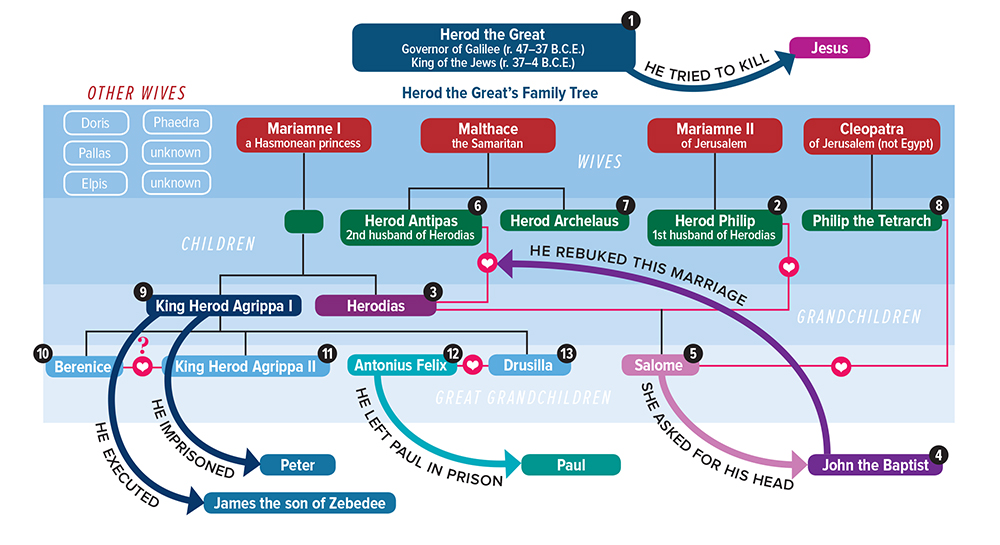
For those that want to follow the drama of Herod the Great’s Family Tree, should take note that Felix was married to Drusilla, the great-grand-daughter of Herod the Great. 

Saturday, May 4, 2024

Acts 21-23:11- Paul's Final Visit to Jerusalem

Acts documents three missionary journeys by Paul:
  • The first missionary journey started in Antioch, looped through Asia-Minor, and back to Antioch, before finishing in Jerusalem.
  • The second started in Jerusalem, went through Antioch, Asia-Minor, went on to Macedonia and Greece, visited Jerusalem, and finished in Antioch.
  • The third would start in Antioch and finish in Jerusalem but focused on Ephesus.
As we just read last week, Paul quickly left the elders of Ephesus at Miletus and sailed quickly to Caesarea and on to Jerusalem.  Paul was driven to get there despite being told multiple times not to go.
  • The disciples at Tyre tell him "through the Spirit" that he should not go to Jerusalem (Acts 21:3-4).
  • The prophet Agebus at Caesarea acts out prophetically how Paul would be bound and led away in Jerusalem (Acts 21:8-12).

Paul pressed on anyway saying "For I am ready not only to be imprisoned but even to die in Jerusalem for the name of the Lord Jesus.” (Acts 21:13b).  While the Spirit was accurately communicating what would occur, Paul was not being commanded through them not to go.

Paul already had his marching orders.

After coming under the protection of the Roman authorities, while he addressed a riotous crowd, he related his conversion experience and the prophetic word from Ananias, who had restored Paul's sight.

And he said, ‘The God of our fathers appointed you to know his will, to see the Righteous One and to hear a voice from his mouth; for you will be a witness for him to everyone of what you have seen and heard.

Acts records three additional times when Paul would receive a direct word from our Lord Jesus Christ.

  • Immediately following his conversion, Paul fell into a trance while praying in the temple and was commanded "Go, for I will send you far away to the Gentiles."(Acts 22:17-21).  This he did with three missionary journeys.
  • On the second missionary journey, having reached Greece, he was told in Corinth “Do not be afraid, but go on speaking and do not be silent, for I am with you, and no one will attack you to harm you, for I have many in this city who are my people.” (Acts 18:9-10).  This he did as he came under the providential protection of the Romans.
  • And after he had testified before the Jewish council in Jerusalem, he was commanded “Take courage, for as you have testified to the facts about me in Jerusalem, so you must testify also in Rome.” (Acts 23:11).
With these marching orders, Paul ignored the warnings of the Christians at Tyre and Caesarea, and used every possible strategy to achieve that goal:
  • He used a plan hatched by James to show people that Paul was still an observant Jew (Acts 21:17-30)
  • He used the protection of the Roman cohort as an opportunity to speak and give his testimony (Acts 21:37-22:23).
  • He used his Roman citizenship into a second opportunity to speak and demonstrate his love for the Jewish Law (Acts 23:1-5).
  • He split the Jewish council down the middle, confounding their efforts to present a unified front against Paul to the Romans (Acts 23:6-10).
  • He began to use the command and control structures of the Roman authorities to start his way to Rome under their protection (Acts 23:31-35).
He did not simply wait for the door to be opened, he opened them.

Saturday, April 27, 2024

Acts 19-20 - Paul in Ephesus/Third Missionary Journey

In Acts 19:1-10, the narrative now catches back up to Paul, who had left Ephesus, leaving behind Priscilla and Aquilla, but now returned to Ephesus after Apollos had moved on to Corinth.  Apollos was described as "eloquent", "fervent in spirit", and that he "taught accurately", but only what he knew (Acts 18:24-25).  So that when Paul arrived he found that key stones were left out of the fledgling church's foundation.

Acts 19:2-3  
And he said to them, “Did you receive the Holy Spirit when you believed?” And they said, “No, we have not even heard that there is a Holy Spirit.” And he said, “Into what then were you baptized?” They said, “Into John's baptism.”

Paul quickly remedies the situation by baptizing them in the name of the Lord Jesus and gives them the evangelistic gifts of the Holy Spirit through the laying on of hands.  This is the last recorded time this had occurred.  Paul understood they needed to be properly grounded and fully equipped.

In Acts 19:11-20, Paul then addresses the sorcery being practiced by "itinerant Jewish exorcists" that included the seven sons of a Jewish high priest named Sceva.  They turn to Christ and hold a book burning to end the practices.

At this point, Paul, through the Holy Spirit receives his marching-orders:

Now after these events Paul resolved in the Spirit to pass through Macedonia and Achaia and go to Jerusalem, saying, “After I have been there, I must also see Rome.” And having sent into Macedonia two of his helpers, Timothy and Erastus, he himself stayed in Asia for a while.

Then, in Acts 19:21-41, Paul and his companions are once again protected by the rule of law, when a riot occurs led by those making a living from the manufacturing of idols.  This was quelled by the town clerk with admonitions that hinted at how Caesar had quelled the riots in Rome (Acts 18:1-3).

Spoiler alert: In subsequent chapters, Paul would use this rule of law (Lex Rex) to reach Rome.

Leaving Ephesus, Paul travels west to Macedonia and then on to Greece, where he spent three months until there was further opposition from the Jews.  At which point he made a key decision:

There he spent three months, and when a plot was made against him by the Jews as he was about to set sail for Syria, he decided to return through Macedonia.

Like the first missionary journey, he chose to return to the churches he planted along the way, rather than simply sailing home.  With his marching order, he understands this will be his last visit.  There would not be a fourth missionary journey.

For Paul had decided to sail past Ephesus, so that he might not have to spend time in Asia, for he was hastening to be at Jerusalem, if possible, on the day of Pentecost.
Now from Miletus he sent to Ephesus and called the elders of the church to come to him.

Strangely though, he did not want to go to Ephesus personally.  He did not want himself to be their sole witness.  Instead, traveling nearby he called for the elders to come to him, so that he could instruct them and they would become the next generation of leadership for Ephesus.  What he said to them is recorded in Acts 20:18-35 (which the reader should pause and read in its entirety), but the core of which is:

Pay careful attention to yourselves and to all the flock, in which the Holy Spirit has made you overseers, to care for the church of God, which he obtained with his own blood.

Once, I had a heated discussion with an anti-gun person.  We spoke of gun-free zones for schools.  But when I spoke of how valuable the children were, the absurdity of their position became obvious even to them.  The children have to be protected with guns.  They are that valuable.

Those in our church were bought with the blood of Christ.  There is nothing more valuable.  We who shepherd and care for the flock need to understand that.


Saturday, April 20, 2024

Acts 17-18 - The World Upside Down/Second Missionary Journey

Paul and his traveling band of evangelists moved on from Phillipi after scaring the authorities who were not giving them the lawful protections due a Roman citizen (Acts 16:16-40).  At Thessalonica Paul did not mince words:

Acts 17:2-3
And Paul went in, as was his custom, and on three Sabbath days he reasoned with them from the Scriptures, 3 explaining and proving that it was necessary for the Christ to suffer and to rise from the dead, and saying, “This Jesus, whom I proclaim to you, is the Christ.”

This once again triggered a divisive response from those who heard their message.  

Acts 17:5-7
But the Jews were jealous, and taking some wicked men of the rabble, they formed a mob, set the city in an uproar, and attacked the house of Jason, seeking to bring them out to the crowd. And when they could not find them, they dragged Jason and some of the brothers before the city authorities, shouting, “These men who have turned the world upside down have come here also, and Jason has received them, and they are all acting against the decrees of Caesar, saying that there is another king, Jesus.”

They had indeed been turning the world upside down.  The Christians were declaring the sacrificial system and the binding and atonement required by the priests unnecessary.  But just as it had occurred in Phillipi, the world of the Jewish religious leaders was being upset even further.

Previously, when they appealed to Pilate, they used Roman law in their favor to crucify Christ.  Now Roman law was being used to protect the Christians, or at least to quell the uprisings.

Acts 17:8-9
And the people and the city authorities were disturbed when they heard these things. And when they had taken money as security from Jason and the rest, they let them go.

In fact, in Berea and in Athens, Paul and his band began to be welcomed!

Acts 17:11
Now these Jews were more noble than those in Thessalonica; they received the word with all eagerness, examining the Scriptures daily to see if these things were so. 
 
Acts 17:19-20
And they took him and brought him to the Areopagus, saying, “May we know what this new teaching is that you are presenting? For you bring some strange things to our ears. We wish to know therefore what these things mean.”

Once in Corinth, we are told how this change of tide began.

After this Paul left Athens and went to Corinth. And he found a Jew named Aquila, a native of Pontus, recently come from Italy with his wife Priscilla, because Claudius had commanded all the Jews to leave Rome. 

During their First Missionary Journey, Paul was often run out of the town by an angry mob, typically of Jews.  The actions of those mobs became so disruptive that in Rome Caesar Claudius eventually commanded all the Jews to leave Rome (Wikipedia Claudius' expulsion of Jews from Rome).  

In high school, I made some off-handed remarks about the captain of the wrestling team to one of his minions.  I soon regretted those words because he and his posse began to humiliate me in the hall-ways.  

With very little of my dignity left, I did the only thing a geek could do, I reported him to the principal as a bully.  The principal took swift action and called both of us to the office.  In a very brief meeting, the bully was told that he would lose his place on the wrestling team, if this meeting ever had to occur again.  

For the remainder of our time in high school, this former bully would avoid being in the same hallway with me.  His world had been turned upside down.


Saturday, April 13, 2024

Acts 15-16 - Jerusalem Council and Call to Macedonia

The work in Antioch among the Gentiles was exploding.  It caught the eye of the circumcision party, who thought that the sign was required to be a Christian.  To settle the matter Paul and Barnabas were sent to Jerusalem to discuss the matter with Apostles and elders (Acts 15:1-35).

There Peter forms the question:

Now, therefore, why are you putting God to the test by placing a yoke on the neck of the disciples that neither our fathers nor we have been able to bear? But we believe that we will be saved through the grace of the Lord Jesus, just as they will.”

Much discussion is allowed to occur.  Paul and Barnabas give testimony.  And then James proposes a solution.  He begins by supporting the statements of Simon Peter:

After they finished speaking, James replied, “Brothers, listen to me. Simeon has related how God first visited the Gentiles, to take from them a people for his name. And with this the words of the prophets agree, just as it is written,
“‘After this I will return,
and I will rebuild the tent of David that has fallen;
I will rebuild its ruins,
     and I will restore it,
that the remnant of mankind may seek the Lord,
    and all the Gentiles who are called by my name,
     says the Lord, who makes these things known from of old.’ 

Note he calls Peter "Simeon", which is the Hebrew pronunciation of "Simon".  Remember please he is speaking with and trying to win over the Jewish portion of the church that was aligned with the Pharisees.

He then quotes from Amos (Acts 15:16-18/Amos 9:11-12) proving to them that God would call the Gentiles as His own.  

And then he does something brilliant.  What he had just quoted was one part of a weekly cycle of readings that have been read in the synagogues since the time of Ezra and the Babylonian Captivity.  They read first from the Torah and then from the Prophets (See Parshah).  The other text that was part of week 30 (Qedoshim) was Leviticus 19:1-20:27.  He used this connection to propose that the Gentiles would only be required to abide by the limited laws contained in that passage (v 21)!

Leviticus 19 is a pleasant break from the ceremonial laws of the book and from the civil laws of Deuteronomy.  It is a condensation of the ten commandments and contains the greatest commandment "you shall love your neighbor as yourself".

This brought the discussion to consensus (dokeĊ) and in Acts 15:22-35, they commit this conclusion to a letter to be circulated.

For it has seemed good to the Holy Spirit and to us to lay on you no greater burden than these requirements . . . 
. . . it has seemed good to us, having come to one accord, to . . .
For it has seemed good to the Holy Spirit and to us to lay on you no greater burden than these requirements . . .

Iv22v25, and v28, the level of consensus is repeatedly emphasized to the point of “one accord” (homothymadon), which Luke uses repeatedly throughout the book to describe the unity of the church.  

This extended even to the Holy Spirit!  How so?  Even though they used an uninspired liturgy to drive the solution, the solution did not violate inspired scripture.

Chapter 16 includes:

  • a disagreement between Paul and Barnabas (Acts 15:38) based on personal opinion which split them into two teams.
  • a unilateral decision to circumcise a non-observant ethnically Jewish Christian to allow their participation in Jewish evangelism Acts 16:3).
  • an internal prompting by the Holy Spirit and dream that changed Paul's direction Acts 16:7,9).

So we have seen in this passage many decision making processes.  Some drive a group to consensus, others split a team apart, still others changes ones own mind.  What ever we choose to do, may it indeed "seem good" to the Holy Spirit.

Week 15 - John 7:32-52 - Rivers of Living Water (Feast of Booths - Part 2)

As a reminder, Jesus initially stayed behind and let His family go on to the Feast of Booths in Jerusalem.  This pilgrimage feast was establ...